(928) 377-5230











Court-ordered and probation-referred addiction treatment is substance use treatment that a judge requires instead of, or alongside, a jail sentence.
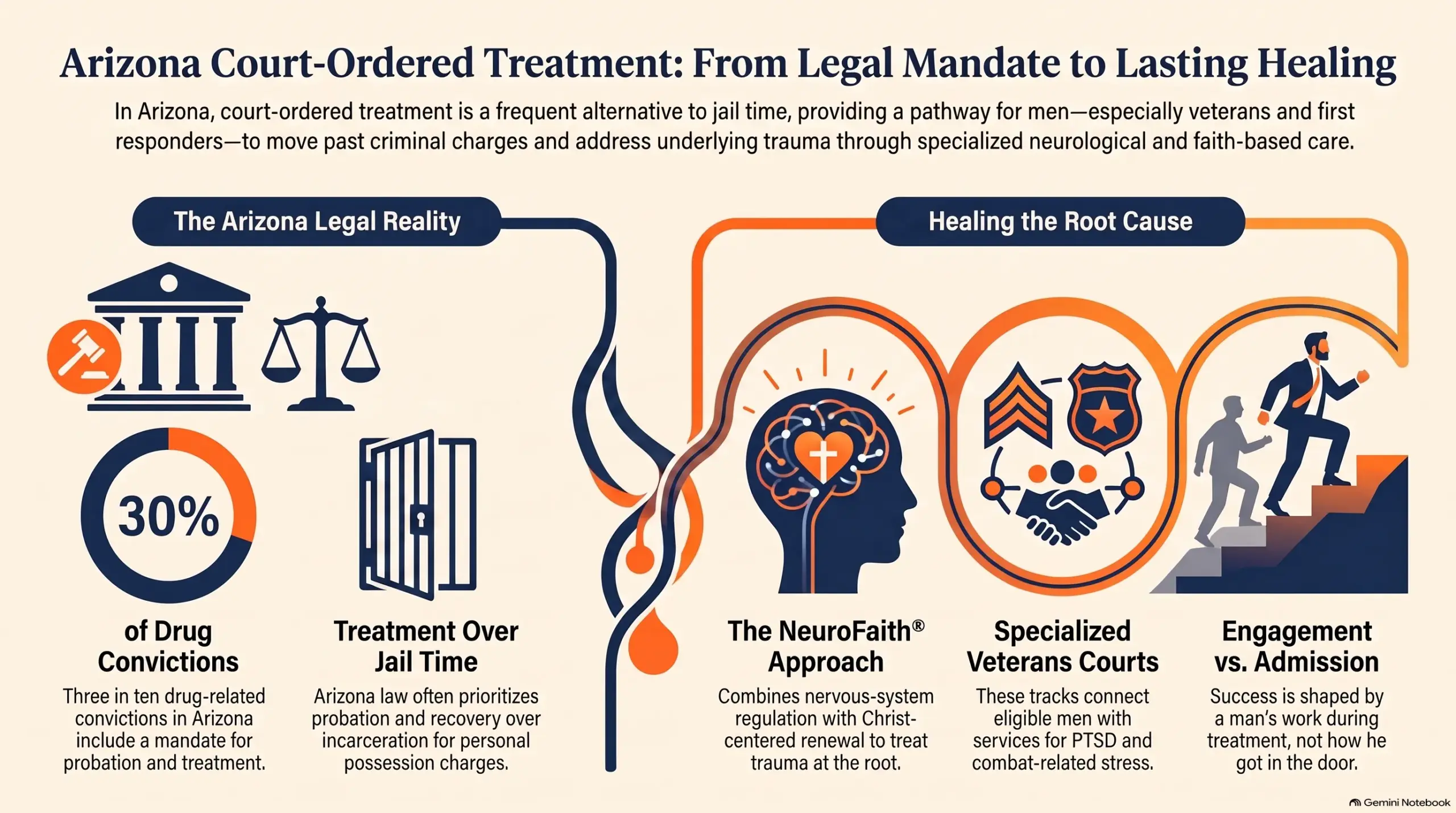
In Arizona, that requirement reaches more men than most expect: a 2026 report from the Arizona Criminal Justice Commission found that roughly three in ten drug-related convictions in the state end in a split sentence pairing jail time with probation and treatment [1].
For a lot of men, that mandate turns out to be the opening they needed to finally deal with what is underneath the charge.
What Court-Ordered Treatment Actually Means for a Man in Arizona
Most of the time, it looks like this: a judge suspends jail time and requires treatment instead, whether through probation, a drug court program, or an agreement to complete treatment before the case is resolved.
Arizona leans on this option more than most states do. A personal possession conviction usually means eligibility for probation with treatment attached, not time behind bars by default [2].
The terms differ by county and by judge, but the shape is almost always the same: an assessment, a level of care, and a probation officer or the court checking in on how it is going.
Does It Matter If I Was Sent Here Instead of Choosing to Come?
Less than most men think. Plenty of honest change AnchorPoint sees starts with a man who arrived under pressure, whether from a spouse, an employer, or a court. Getting sent here is not the same as failing to get here on your own. What actually shapes the outcome is what happens once a man is in the work, not how he got in the door.
 Why the Charge Is Rarely the Real Problem
Substance use rarely shows up on its own. For the veterans, first responders, and men carrying combat or childhood trauma who make up much of AnchorPoint’s community, the behavior behind a charge is usually a symptom of a nervous system that never got the signal it was safe to stand down.
That is the whole premise behind the NeuroFaith® model, as developed by Dr. Jeffrey E. Hansen, PhD, the clinical foundation both AnchorPoint and our brother program, Holdfast Recovery, are built on. NeuroFaith™ combines nervous-system regulation and trauma research with Christ-centered renewal, working at the root instead of managing the symptom.
For veterans specifically, Arizona has built a track for this: veterans courts connect eligible men with the Arizona Department of Veterans’ Services to address the PTSD, brain injury, or combat-related substance use sitting underneath the charge [3]. Treatment tends to work when a man stays engaged with it over time, not when he happened to want it walking through the door [4].
What If My Case Involves PTSD or Combat-Related Stress?
Say so early, to your attorney and to any treatment provider you are considering. A documented link between service-related trauma and a charge can open the door to a veterans court track, and it should shape the treatment plan itself, not just the sentence.
What Recovery Looks Like at AnchorPoint
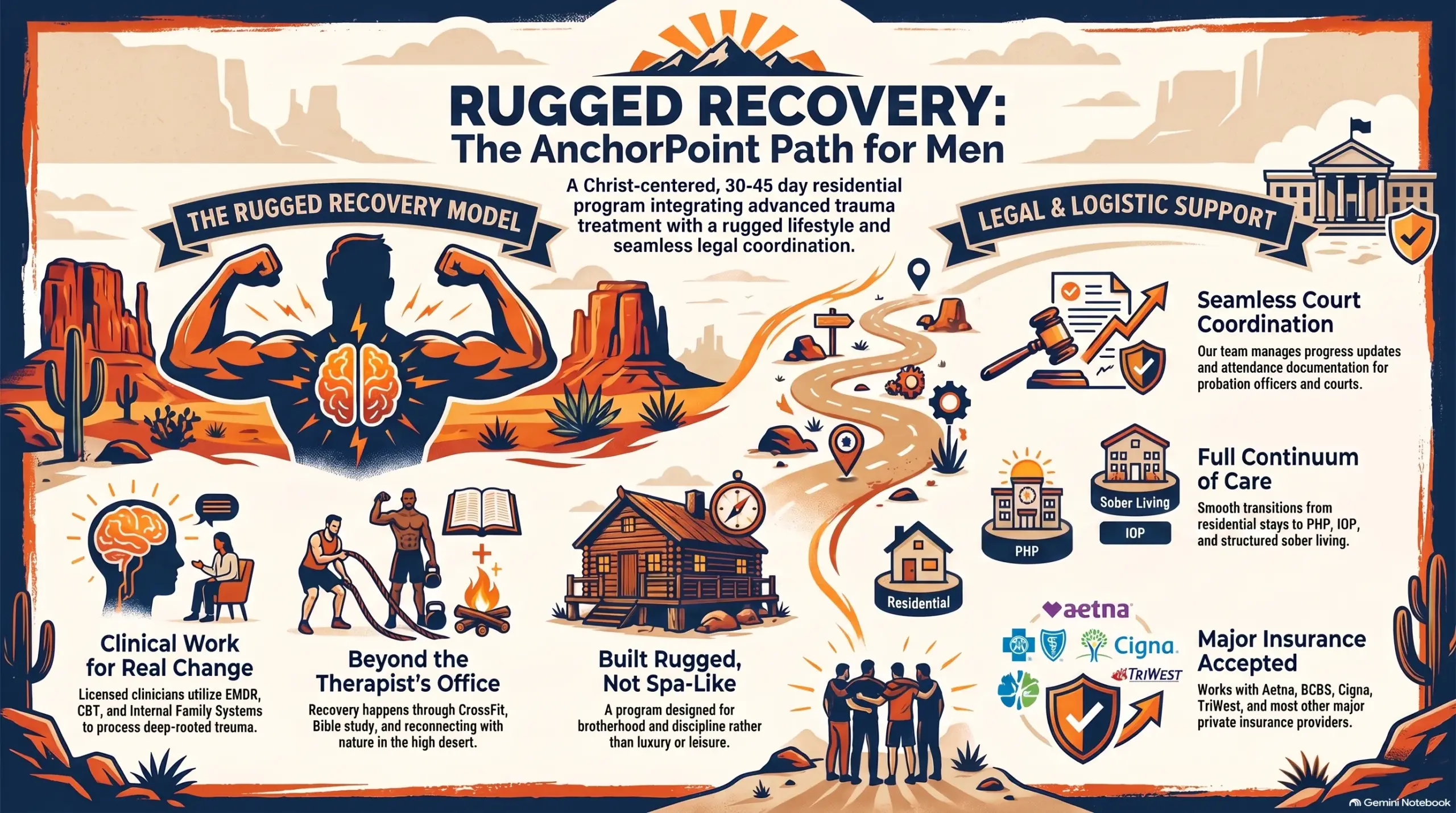
AnchorPoint’s residential program runs 30 to 45 days, and the days are full: individual and group sessions, licensed clinicians, and round-the-clock care. But the structure is only half of it. Recovery here happens on a CrossFit floor, in a Bible study that does not feel like a lecture, and out on the Prescott high desert, getting outside, off the screen, and reconnecting with himself, the men beside him, and God.
Men carrying trauma work through it with Eye Movement Desensitization and Reprocessing (EMDR), Cognitive Behavioral Therapy (CBT), and Internal Family Systems, run by licensed clinicians alongside daily individual and group therapy. It is real clinical work, not just talk, and it is what builds the discipline of a man who is done running.
Staying in Step With the Court While You Do the Real Work
Plenty of men move through residential care and step down into intensive outpatient programs without losing momentum or clinical continuity. If a probation officer or a court needs attendance confirmation or a progress update along the way, our team handles that too, once the right releases are signed.
Will AnchorPoint Communicate With My Probation Officer or the Court?
Yes, with the proper releases signed. Requirements vary by jurisdiction, so bring any paperwork with you, or have your attorney send it ahead of admission, and our team will take it from there.
What Matters Most
- Getting sent to treatment by a court does not change whether the work is real. What happens once a man is here is what matters most.
- Substance use is rarely the actual problem. For many of the veterans and first responders, it is a symptom of trauma the nervous system never fully processed.
- Recovery at AnchorPoint runs through brotherhood, strength training, and the Arizona high desert, built rugged, not spa-like.
- AnchorPoint keeps men in step with legal requirements, including documentation and step-down care, without losing sight of the deeper work.
 A Legal Requirement Can Be Where Real Change Starts
AnchorPoint Recovery is a Christ-centered residential program for men in Prescott, Arizona, built for addiction, trauma, and the co-occurring conditions that often come with them.
With our brother program, Holdfast Recovery, we offer a full continuum from residential care through PHP, IOP, and sober living. We work with most major insurance companies, including Aetna, BlueCross BlueShield, Cigna, United Healthcare, Humana, GEHA, Carelon, ComPsych, TriWest, and MultiPlan; we do not accept Medicare or Medicaid.
Speak With Admissions
Reach out to AnchorPoint’s admissions team to talk through your situation, verify your insurance, and figure out the next step, with no cost or obligation.
Sources
[1] Arizona Criminal Justice Commission. 2026. Drug, Gang, and Violent Crime Control Strategy 2026–2031. Arizona Criminal Justice Commission.
[2] Justia. 2024. Arizona Revised Statutes § 13-901.01. Justia.
[3] Arizona Department of Veterans’ Services. n.d. Veteran Courts. Arizona Department of Veterans’ Services.
[4] National Institute on Drug Abuse. 2020. Criminal Justice DrugFacts. National Institute on Drug Abuse.