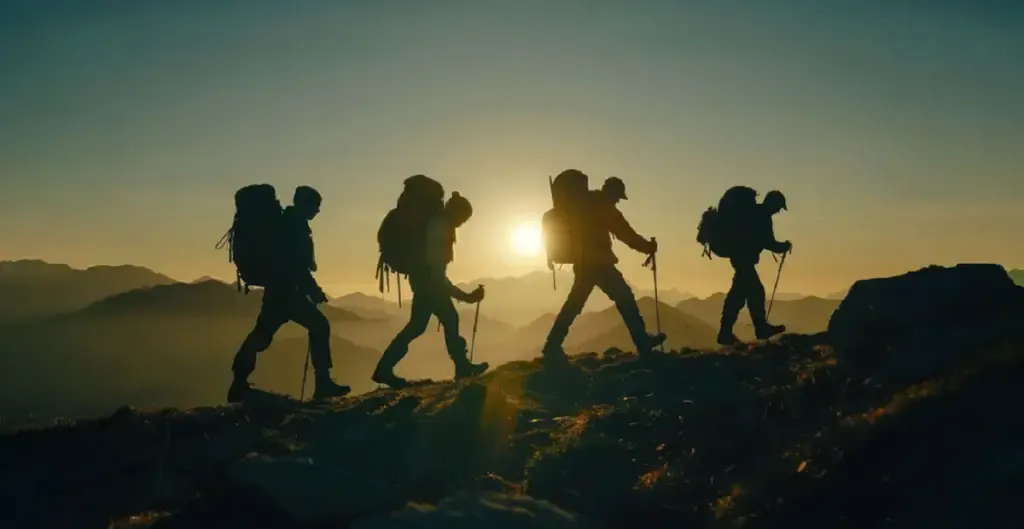
Real change for men often happens when they’re moving, working, and pushing through something difficult. Adventure-based therapy helps men tap into those skill sets and shared connections. Whether navigating a trail, carrying weight, or solving a challenge with a team, the mind becomes quiet from negative thought loops or cravings.
Most adventure therapy programs are designed as group experiences. Working side by side with others in challenging outdoor activities creates a sense of brotherhood and shared purpose. Participants not only face physical and mental challenges together but also practice communication, problem-solving, and trust in real time.
Men at AnchorPoint learn from each other’s successes and setbacks, giving and receiving support while holding one another accountable. This combination of shared effort and reflection accelerates personal growth, strengthens confidence, and builds connections that often last far beyond the adventure itself.
What Is Adventure Therapy?
Adventure therapy is a treatment approach that often takes place outdoors in the wilderness and includes physical activities. It is used to help individuals recovering from substance use and co-occurring mental health disorders.
Adventure therapy combines components of traditional psychotherapy and experiential learning. Trained mental health professionals often guide activities that help clients learn their strengths, achieve goals, and develop skills for independence [1].
Adventure therapy helps participants solve problems, build trust, and increase their communication and collaboration skills. These adventure-based programs are often hosted by the treatment center or program and may include a range of activities such as:
- Rock climbing
- Hiking
- Paddleboarding
- Camping
- Building
- Mountain biking
- Fishing
- Swimming
- Skiing or Snowboarding
- Surfing
The Benefits of Group Adventure Therapy for Men
Disconnect In Nature and Build Brotherhood Outdoors
Being out in nature, away from noise, screens, and constant pressure, allows the body to slow down and the mind to clear. Outdoors, men aren’t competing over status or hiding behind roles; they’re facing the same terrain together. That shared environment creates a natural sense of brotherhood.
Working through obstacles side by side builds trust faster than sitting across from someone in a quiet room. What starts as a group of individuals becomes a team, and that sense of brotherhood becomes one of the strongest factors for transformation and growth.
Develop Trust Faster Than Traditional Therapy
Shared outdoor challenges create a kind of trust that rarely forms in conventional therapy because people are cooperating under real pressure instead of only talking about it. When two or more people are setting up camp before dark or figuring out how to cross a stream safely, their attention shifts toward solving an immediate problem together.
The environment also increases emotional openness and shared vulnerability because nature strips away many of the cues that normally shape guarded behavior. Phones are often left behind or go into backpacks, signals of status or wealth don’t matter as much, and people experience the same weather and uncertainty at the same time.
Research on bonding under stress suggests that coordinated effort and mild adversity increase perceptions of reliability and empathy, which explains why teammates on expeditions, search-and-rescue units, or wilderness programs often report quick trust formation [2].
Rebuild Communication and Confidence
Group experiences give men a practical setting to rebuild communication because the interaction happens around shared activity rather than forced emotional discussion. In many traditional settings, men are expected to immediately articulate feelings in a direct way, which can create pressure and silence rather than openness.
Conversations about strategies, setbacks, training together, and problem-solving often feel more like collaboration for men than a forced discussion. Over time, these repeated low-risk interactions reduce self-consciousness and allow men to speak honestly without feeling that every statement is being analyzed [3].
What Men Can Expect In Adventure Therapy at AnchorPoint
At AnchorPoint Recovery, men experience a mix of endurance, skill-building, and connection to the outdoors across Arizona’s diverse landscapes. From rugged canyon climbs to desert trail navigation and pine-covered mountain treks, the environment becomes a training ground for resilience, confidence, and teamwork.
Some of the activities we offer for men include:
Desert and Mountain Hiking: Guided treks across Arizona’s canyons, rocky trails, and forested slopes build endurance, mental focus, and the ability to handle stress under pressure.
Rock Climbing: Tackling cliffs and boulders teaches men how to face fear, trust their skills, and grow confidence while managing controlled risk.
Donkey-Assisted Therapy: Working with and caring for donkeys helps men process emotions through action, build trust, and strengthen empathy in a hands-on, grounded way.
Survival Skills Training: Learning to navigate streams, build fires, and construct shelters hones self-reliance, problem-solving, and adaptability in real-world situations.
Team Challenges: Obstacle courses and group missions push men to collaborate, communicate, and rely on one another under pressure, forging bonds that last beyond the trail.
Outdoor Therapy for Men in Arizona
Through a blend of evidence-based therapies, social supports, case management, integrated wellness, strength training, and outdoor adventure-based experiences, we help men heal the root cause of addiction and grow in a supportive, Christ-centered environment.
At AnchorPoint, our programs are rooted in neuroscience and guided by the Neurofaith™ model, focusing on strengthening the nervous system, heart, and brain. We offer several levels of care to guide you through your recovery journey from start to finish.
Discover the adventure and joy in sobriety. Contact our admissions team to verify your insurance benefits today.
Sources
[1] Friedman, H. 2025. Adventure Therapy: 7 Exciting Activities That Accelerate the Healing Process. Recovery.com.
[2] Seppala, E. 2012. How the Stress of Disaster Brings People Together. Scientific American.
[3] Kaine, C. et al. (2023). Understanding Men’s Engagement and Disengagement When Seeking Support for Mental Health. American journal of men’s health, 17(2), 15579883231157971.