(928) 377-5230

Tim Hayden
Co-Founder
Tim is passionate about serving others, leading people to Christ, and more specifically breaking the stigma of addiction and mental health in the Church and across the world. Tim merges his desire to further the Kingdom with 18 years of experience in the Corporate IT world where his background has ranged from working for small startups to leading national teams at global software companies. Tim graduated from Mount Vernon Nazarene University with a bachelor’s degree in Business Administration, Marketing, and Communications. Tim and his wife are active in their church community serving in the youth department, marriage mentoring, and life group mentoring. In his spare time, Tim enjoys spending time with his family in the great outdoors camping, mountain biking, and snowboarding.
“Do all the good you can, by all the means you can, in all the ways you can, in all the places you can, at all the times you can, to all the people you can, as long as ever you can.” – John Wesley











For many men in recovery, the hardest part isn’t putting down the substance. It’s facing the people they hurt while they were using. Step 9 of the 12 Steps asks exactly that: to make direct amends to those we’ve harmed.
It’s one of the most intimidating steps in the program, and for good reason. But it’s also where some of the deepest healing happens, both for the man making amends and for the relationships addiction nearly destroyed.
At AnchorPoint Recovery, we approach Step 9 through our NeuroFaith™ model, which brings together the spiritual wisdom of the 12 Steps, current understanding of the brain and nervous system, and a Christ-centered framework.
Here’s what that looks like in practice and why restoring relationships is so central to a man’s recovery.
What Is AA Step 9?
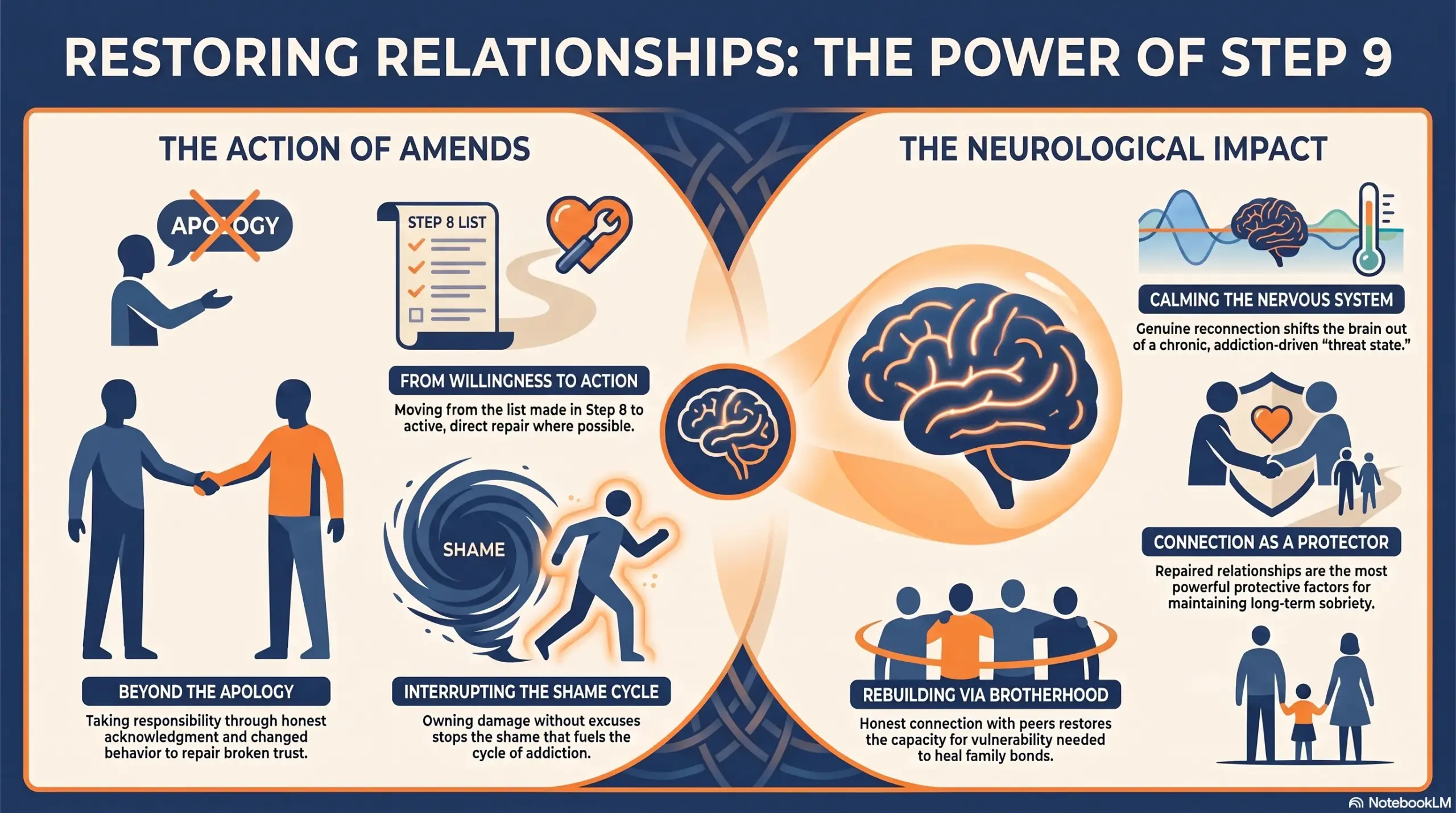
Step 9 reads, “Made direct amends to such people wherever possible, except when to do so would injure them or others.” In plain terms, it’s about taking responsibility, going to the people you’ve harmed, and making things right through honest acknowledgment, changed behavior, and, where appropriate, repair [1].
Step 9 builds on the work of Step 8, where a person lists everyone they’ve harmed and becomes willing to make amends. Step 9 is where that willingness becomes action. It’s not about groveling or endless apologies. It’s about clearly owning the damage, without excuses, and demonstrating through action that things are genuinely different now.
Why Is Making Amends So Important in Recovery?
Addiction is rarely a solo event. By the time a man enters treatment, there’s usually a trail of broken trust behind him, missed moments, broken promises, and the slow erosion of relationships with the people who love him most. That damage doesn’t just sit in the past. It actively fuels the shame that keeps the cycle of addiction turning.
Making amends interrupts that cycle. Research consistently shows that strong social support and repaired relationships are among the most powerful protective factors in long-term recovery. When a man reconnects with his family and community, he gains something a substance never gave him: a reason to stay well and people who will hold him to it [2].
There’s also a neurological piece, which is where NeuroFaith™ comes in. Shame and isolation keep the nervous system locked in a chronic threat state, the same survival mode that drives so much substance use in the first place. Genuine reconnection, being truly seen and accepted by another person, helps regulate the nervous system. In other words, restored relationships don’t just feel good. They physically help calm the body and brain that addiction kept on high alert.
 Why Do Men Struggle More With Connection and Isolation?
Step 9 carries particular weight for men. Many men are raised to equate vulnerability with weakness, to handle things alone, to never let anyone see them struggle. That conditioning runs deep, and addiction exploits it ruthlessly. The more a man uses, the more he isolates, and the more isolated he becomes, the more he uses [3].
By the time many men reach AnchorPoint they’ve spent years cut off, not just from family, but from any real, honest connection with other men. They’ve learned to perform competently while privately falling apart. Making amends asks them to do the opposite: to be honest, to admit fault, to let people back in.
This is exactly why brotherhood is so central to how we work. For a lot of men, the first relationships they restore aren’t with family at all; they’re with the other men in treatment alongside them. Doing hard, honest work shoulder-to-shoulder with men who understand rebuilds the capacity for connection that isolation destroyed. Once a man relearns how to be honest with his brothers, making amends with his family becomes possible.
How Does NeuroFaith™ Support Restoring Relationships?
At AnchorPoint, Step 9 isn’t a conversation a man has alone. It’s supported by real clinical work designed to make repair possible and lasting.
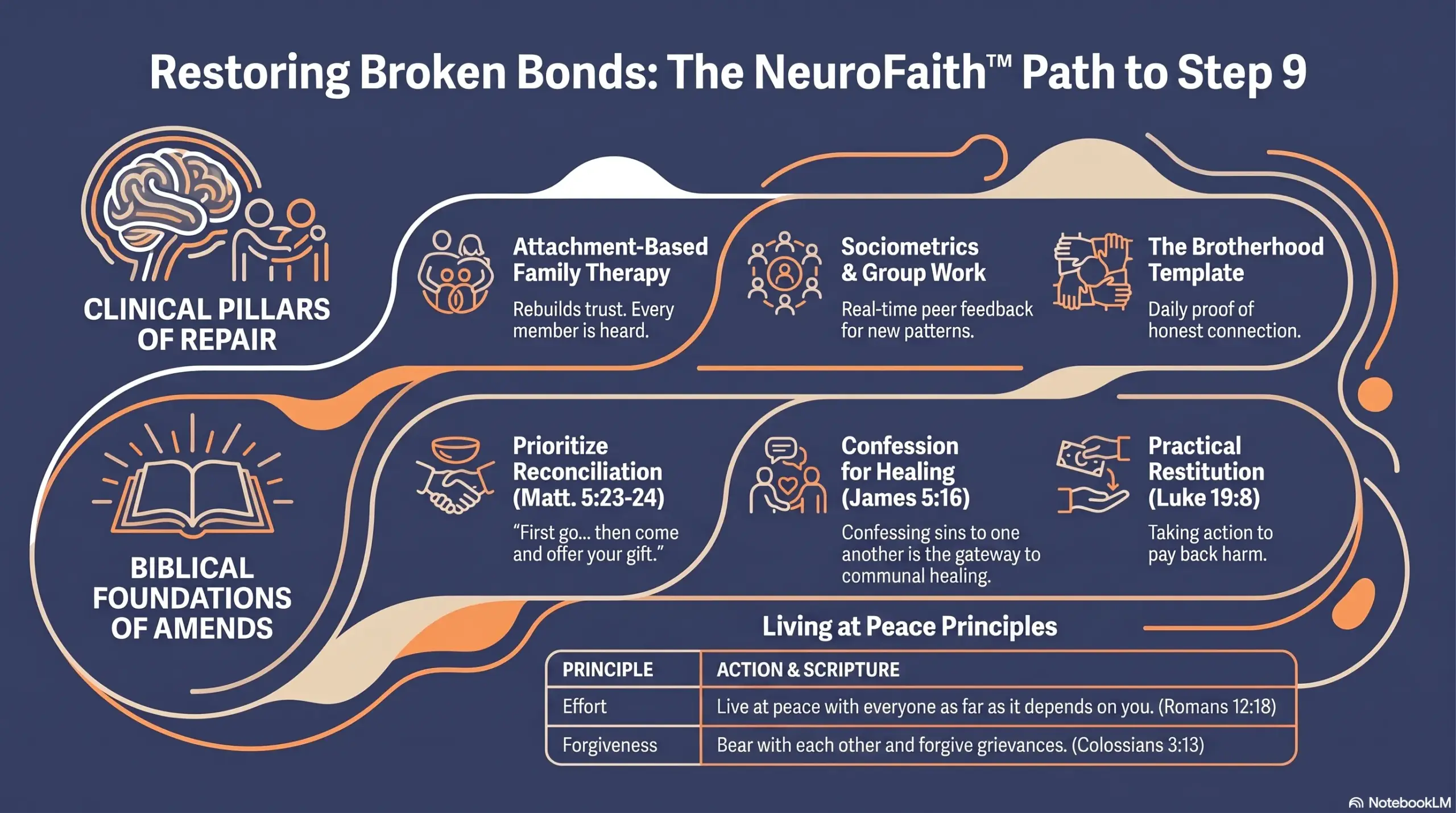
Family therapy sits at the heart of it. AnchorPoint works with a lot of fathers, sons, brothers, and husbands, and the relationships that addiction strains are often the ones most worth fighting for. Attachment-based family therapy helps repair broken bonds, not by pretending the harm didn’t happen, but by rebuilding trust in a structured, supported way where everyone is heard.
Sociometrics and experiential group work help men see the relational patterns they’ve been stuck in and practice new ones in real time, with immediate feedback from others who are doing the same.
Peer and brotherhood support provide the daily proof that honest connection is possible and survivable. The bonds formed in a recovery community become a template for the relationships a man rebuilds outside it.
5 Bible Verses That Support Step 9
Matthew 5:23-24: “Therefore, if you are offering your gift at the altar and there remember that your brother or sister has something against you, leave your gift there in front of the altar. First go and be reconciled to them; then come and offer your gift.”
James 5:16: “Therefore confess your sins to each other and pray for each other so that you may be healed.”
Luke 19:8: “But Zacchaeus stood up and said to the Lord, ‘Look, Lord! Here and now I give half of my possessions to the poor, and if I have cheated anybody out of anything, I will pay back four times the amount.’”
Romans 12:18: “If it is possible, as far as it depends on you, live at peace with everyone.”
Colossians 3:13: “Bear with each other and forgive one another if any of you has a grievance against someone. Forgive as the Lord forgave you.”
Restoring What Addiction Took: Men’s Rehab in Arizona
Step 9 is hard because it’s real. It asks a man to stop hiding, to own his impact, and to do the slow work of rebuilding what was broken. But it’s also where recovery stops being only about not using and starts being about building a life worth staying sober for, surrounded by people who are genuinely glad to have him back.
At AnchorPoint Recovery, a men’s Christian rehab in Arizona, we walk that road with men every day. If you or a man you love is ready to do the deeper work of recovery, including repairing the relationships addiction has strained, we’re here.
Reach out today for a real conversation about what recovery could look like.
 Sources
[1] Alcohol.org, et al. (n.d.). Step 9 of AA: Making amends to those you’ve harmed. American Addiction Centers.
[2] Jason, L. A. (2023). The Importance of Social Support in Recovery Populations: Toward a Multilevel Understanding. Alcoholism Treatment Quarterly, 41(2), 222–236.
[3] Oliffe J. L. (2023). Connecting Masculinities to Men’s Vulnerabilities and Resilience to Illness. Qualitative Health Research, 33(14), 1322–1332.