(928) 377-5230

Tim Hayden
Co-Founder
Tim is passionate about serving others, leading people to Christ, and more specifically breaking the stigma of addiction and mental health in the Church and across the world. Tim merges his desire to further the Kingdom with 18 years of experience in the Corporate IT world where his background has ranged from working for small startups to leading national teams at global software companies. Tim graduated from Mount Vernon Nazarene University with a bachelor’s degree in Business Administration, Marketing, and Communications. Tim and his wife are active in their church community serving in the youth department, marriage mentoring, and life group mentoring. In his spare time, Tim enjoys spending time with his family in the great outdoors camping, mountain biking, and snowboarding.
“Do all the good you can, by all the means you can, in all the ways you can, in all the places you can, at all the times you can, to all the people you can, as long as ever you can.” – John Wesley











More than one in ten veterans carry a substance use disorder diagnosis, a rate that runs above the general population [1]. For many families, the real question is not whether a veteran is willing to get help, but whether the Department of Veterans Affairs (VA) will pay for it. The answer depends on where a veteran seeks care, and it is more workable than most families realize.
Why This Question Matters for Veterans and Their Families
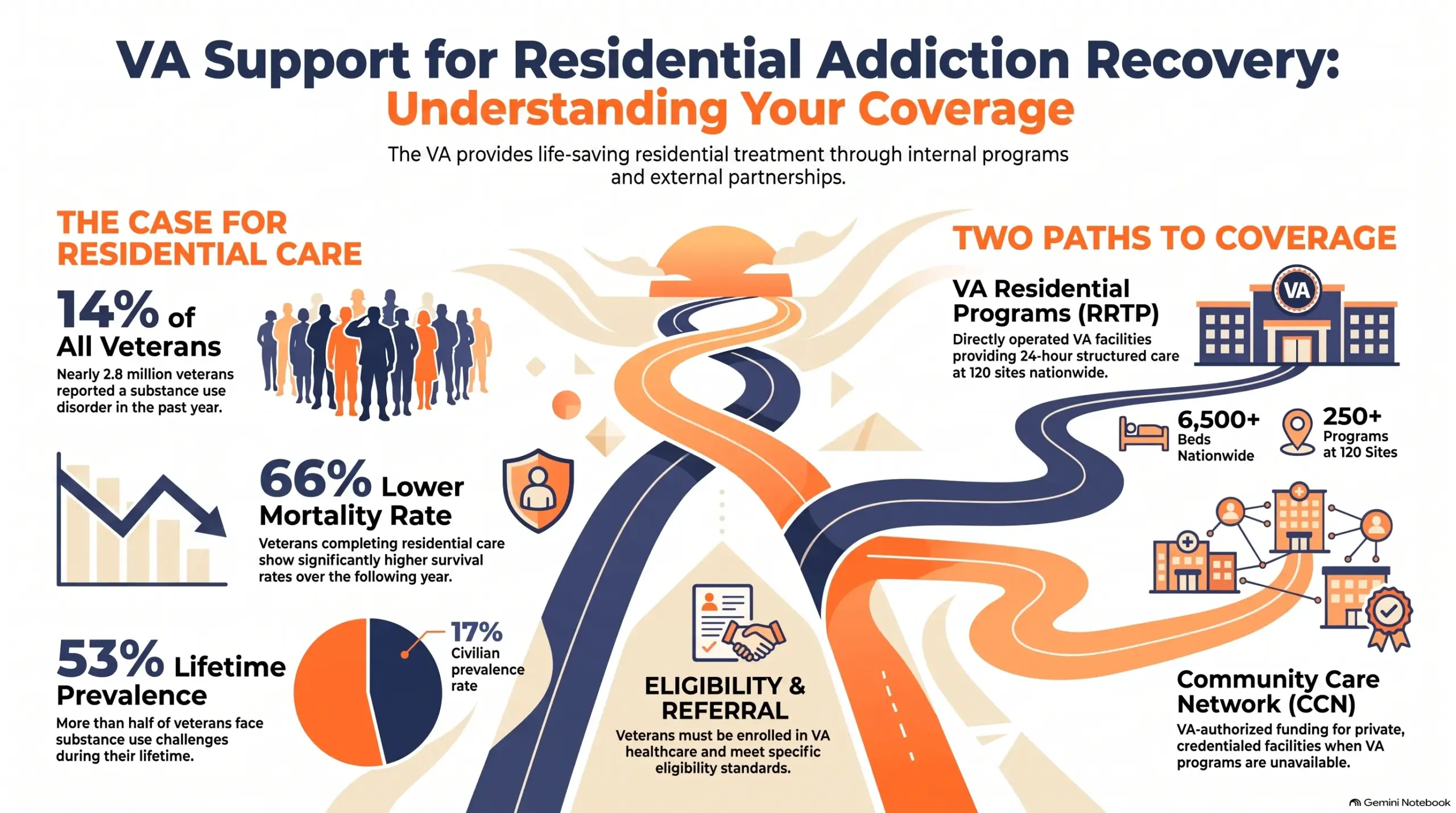
Nearly 2.8 million veterans, about 14% of all veterans nationwide, reported having at least one substance use disorder in the past year [2]. Lifetime prevalence runs even higher, at an estimated 53%, compared to roughly 17% of civilians [3].
What often stalls the conversation is the assumption that VA benefits either cover everything or nothing. Neither assumption is quite right. For a man used to solving his own problems, asking whether the VA will pay for help is not a retreat. It is the same tactical thinking that got him through deployment: know the terrain before you move.
How Does VA Health Care Cover Residential Addiction Treatment?
The VA funds residential addiction treatment in two distinct ways: directly, through its own residential programs, and indirectly, by paying for care at approved private facilities in the community. Which path applies determines where a veteran can go, and how quickly he can get there.
What Is a VA Residential Rehabilitation Treatment Program?
A Residential Rehabilitation Treatment Program (RRTP), sometimes called domiciliary care, is a VA-operated facility providing twenty-four-hour structured treatment for veterans working through substance use disorder, Post-Traumatic Stress Disorder (PTSD), and related mental health conditions [4].
The VA operates more than 250 of these programs at roughly 120 sites nationwide, with capacity for more than 6,500 veterans at a time [4]. These programs are not a last resort. Veterans who completed residential treatment for substance use disorder had a 66 percent lower mortality rate in the following twelve months, compared to veterans who did not receive that care [5]. Access to a bed still depends on medical readiness, referral, and site availability.
 Does the VA Ever Pay for Residential Treatment Outside Its Own Facilities?
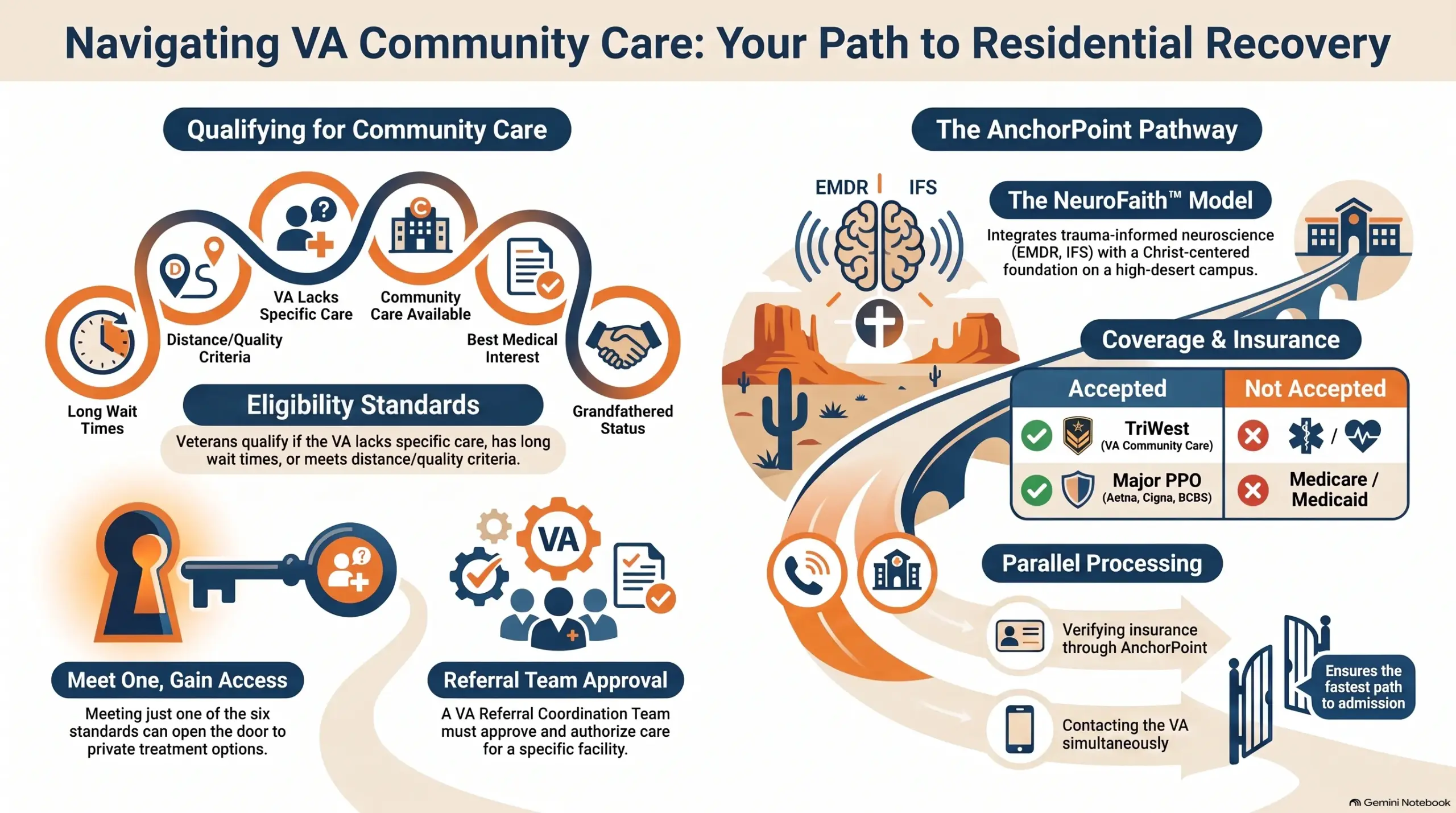
Yes. Through the VA Community Care Network (CCN), the VA can authorize and pay for residential substance use treatment at private, credentialed facilities when its own programs cannot meet a veteran’s need in time or location [6].
CCN divides the country into regional networks, each managed by a third-party administrator. In Arizona and the rest of the western United States, TriWest Healthcare Alliance administers this benefit as the Region 4 contractor [6].
At AnchorPoint, we accept TriWest among other insurance, positioning us to receive VA Community Care referrals for eligible veterans across the region.
Who Qualifies for VA Community Care Residential Treatment?
Community care through the VA is not automatic. A veteran must be enrolled in VA health care and meet at least one of six eligibility standards before a referral to a private facility can be approved [7].
What Are the Six Eligibility Standards for VA Community Care?
- The VA does not offer the specific level of care a veteran needs at any of its facilities.
- The veteran lives in a state or territory without a full-service VA medical facility.
- The veteran qualified under the former forty-mile distance rule and still meets that standard.
- The VA cannot schedule the needed care within its access standards for average drive time or appointment wait time.
- A VA provider determines that community care is in the veteran’s best medical interest.
- The VA facility that would provide the care does not meet the VA’s own quality standards.
Meeting even one standard can open the door to treatment outside the VA system, though a VA Referral Coordination Team must approve it first [7].
How Does a Veteran Actually Start the Process?
A veteran typically starts through his own VA primary care or mental health provider, or by calling the VA’s community care line. A Referral Coordination Team reviews eligibility and issues an authorization for a specific facility and level of care once approved.
AnchorPoint’s admissions team can coordinate with his local VA medical center at the same time to shorten the timeline.
What This Means for a Veteran Considering AnchorPoint
AnchorPoint accepts TriWest, along with Aetna, Cigna, Blue Cross Blue Shield, and several other major Preferred Provider Organization (PPO) plans, giving many veterans in the western United States a coverage pathway into our residential care.
AnchorPoint is a residential treatment center. In partnership with our brother program, Holdfast Recovery, we provide a step-down process into a Partial Hospitalization Program (PHP) and a two-phase Intensive Outpatient Program (IOP), meeting five days a week for three hours or three days a week for three hours, along with structured sober living, once residential treatment is complete.
AnchorPoint does not accept Medicare or Medicaid, so a veteran relying on either alone should explore VA channels directly. Community care approval depends on the specific eligibility standard he meets and VA-run care availability in his area.
AnchorPoint’s admissions team verifies insurance directly, at no cost and with no obligation, before a man makes any decision.
What Should a Veteran or Family Member Do First?
Call AnchorPoint or submit an insurance verification request, and let the admissions team confirm TriWest or other benefits without cost or pressure. At the same time, or beforehand if there is time, contact the VA’s local Referral Coordination Team to confirm community care eligibility. Pursuing both paths at once, rather than waiting on one before starting the other, tends to move a veteran into treatment faster.
How AnchorPoint Supports Veterans
AnchorPoint’s Veteran’s Program helps men break the grip of old trauma patterns, steady a nervous system trained for combat, and reconnect with a community that understands what they carried home.
Clinical work draws on Cognitive Behavioral Therapy (CBT), Eye Movement Desensitization and Reprocessing (EMDR), and Internal Family Systems (IFS), all housed under the NeuroFaith® model, as developed by Dr. Jeffrey E. Hansen, PhD.
NeuroFaith™ pairs trauma-informed neuroscience with a Christ-centered foundation, aimed at getting to the root of a man’s trauma rather than only managing the symptom of substance use.
Men also work through HeartMath™ coherence training, daily strength training, and CrossFit-style conditioning.
None of it is styled like a spa retreat. It happens on a working high desert campus, built for getting outdoors, off the screen, and into open country.
 What Matters Most
- The VA covers residential treatment two ways: directly through its own Residential Rehabilitation Treatment Programs, and indirectly through the VA Community Care Network at approved private facilities.
- AnchorPoint accepts TriWest, positioning the program for VA Community Care referrals, alongside PPO plans such as Aetna, Cigna, and Blue Cross Blue Shield.
- AnchorPoint provides residential treatment; step-down PHP, IOP, and sober living continue through our brother program, Holdfast Recovery.
- AnchorPoint does not accept Medicare or Medicaid; veterans relying on those alone should explore VA channels directly.
- Verifying benefits early, through AnchorPoint and the VA’s Referral Coordination Team, is the fastest path from question to admission.
Confidential Help Is One Call Away
AnchorPoint Recovery is a Christ-centered residential treatment program for men in Prescott, Arizona, built around brotherhood and evidence-based clinical care on a high desert campus.
The program treats addiction alongside the trauma that drives it, including combat trauma, first responder trauma, and a life that has gotten harder to carry alone. A veteran does not have to guess whether his benefits will work here.
Speak With Admissions Today
Call (928) 377-5230
Sources
[1] National Institute on Drug Abuse. 2025, Jan. 30. Substance Use and Military Life. DrugFacts, National Institute on Drug Abuse.
[2] U.S. Department of Veterans Affairs, Health Services Research and Development. n.d. Substance Use Disorders. HSR&D Research Topics, U.S. Department of Veterans Affairs.
[3] R Street Institute. 2025, Jul. 2. Substance Use Disorders in the Veteran Population. Commentary, R Street Institute.
[4] U.S. Department of Veterans Affairs, Office of Mental Health and Suicide Prevention. n.d. VA Mental Health Residential Rehabilitation Treatment. U.S. Department of Veterans Affairs.
[5] U.S. Department of Veterans Affairs. 2024, Oct. 27. Veterans Get Faster Access to Residential Treatment. VA News, U.S. Department of Veterans Affairs.
[6] U.S. Department of Veterans Affairs. 2026, Jul. 6. Community Care Network. Veterans Health Administration, U.S. Department of Veterans Affairs.
[7] U.S. Department of Veterans Affairs. 2024, Dec. Community Care Eligibility. Fact Sheet, U.S. Department of Veterans Affairs.