(928) 377-5230











Roughly 74% of American adults who have ever had a drug or alcohol problem now consider themselves in recovery or recovered [1].
Almost none of them got there in 30 days. Residential treatment stabilizes a man and gets to the root of what he has been carrying. What he does in the year after discharge decides whether that work holds. Here is what the next stage looks like.
Why the Year After Discharge Decides the Outcome
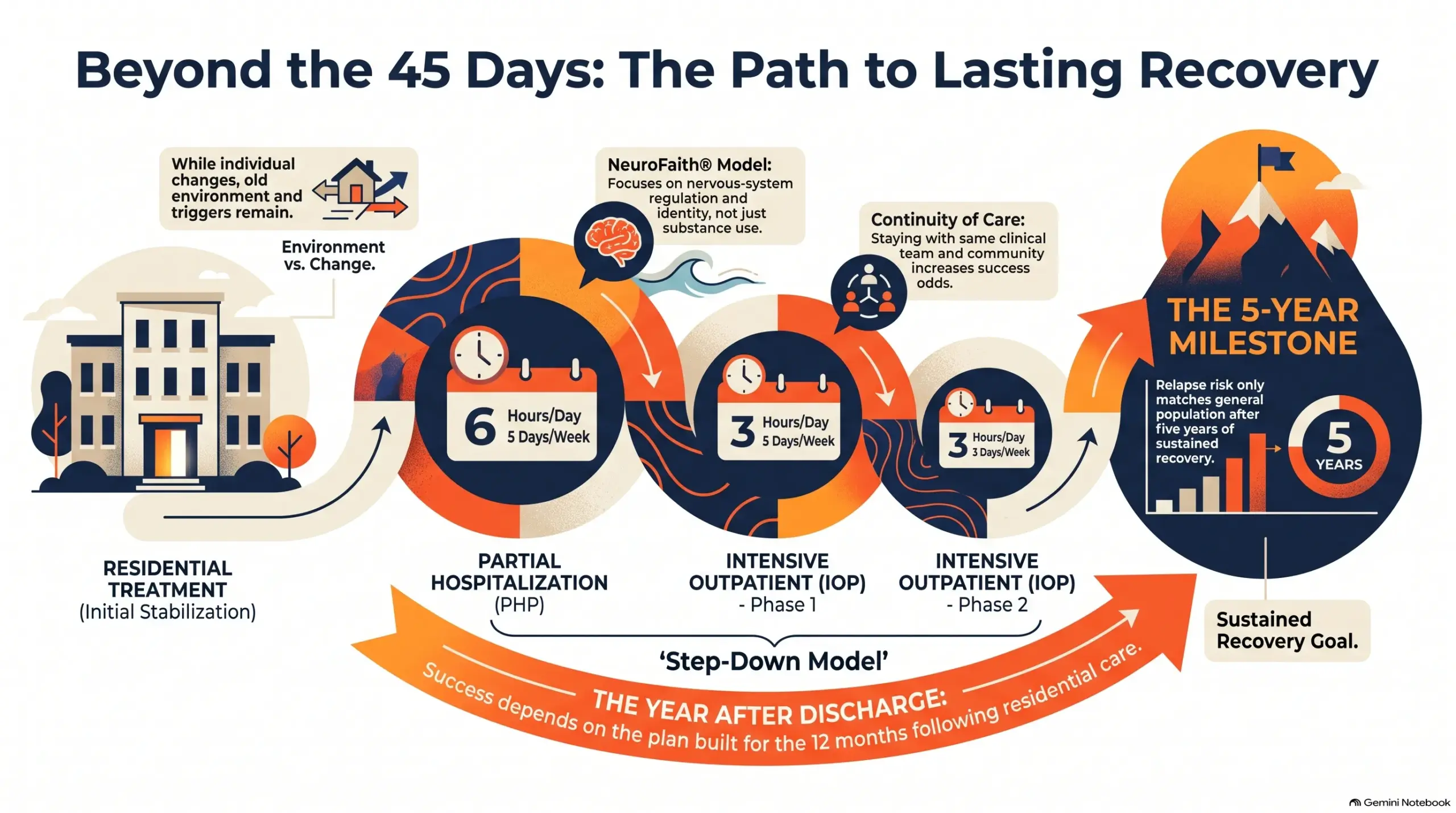
Residential treatment does something no outpatient schedule can. It takes the substance out of reach, settles a nervous system that has been running hot for years, and gives a man 30 to 45 days to face what is underneath the drinking or using.
Then the doors open. The same job site, drive home, and contacts in his phone are all still there. Nothing on the outside changed while he did.
The research on this is clear. Most men who reach lasting recovery need more than one attempt, and the odds of a return to use do not fall to the level of the general population until roughly five years of sustained recovery [2].
That is not a reason to lose motivation. It is a reason to build a plan that runs longer than 45 days.
How Long Does the Risk of Relapse Stay Elevated?
The sharpest risk sits in the first weeks and months after leaving a structured setting, when tolerance is low and the old environment is unchanged. Risk drops steadily with time in recovery, but researchers put the crossover point, where a man in recovery carries no more risk than anyone else, at around the five-year mark [2].
The longer a man stays connected to structure and to other men, the better his odds.
The Step Down: Partial Hospitalization and Intensive Outpatient
AnchorPoint is a residential program. In partnership with our brother program, Holdfast Recovery, the man steps down into a Partial Hospitalization Program (PHP) that runs six hours a day, five days a week, and then into a two-phase Intensive Outpatient Program (IOP) that meets five days a week for three hours, or three days per week for three hours.
Same clinical leadership. Same clinical model. Many of the same men in the room. Both programs are built on the NeuroFaith® model, as developed by Dr. Jeffrey E. Hansen, PhD, which treats nervous-system regulation, trauma, and identity in Christ as the root instead of the substance use alone. A man does not restart that work with a stranger at a new address. He continues it.
That continuity is worth more than most men expect. Reviews of continuing care research find that the programs producing consistent results are the longer ones that actively keep a man engaged rather than waiting for him to call [3].
 Do I Have to Leave Prescott to Continue Treatment?
No. AnchorPoint and Holdfast Recovery operate in the same community, so a man finishes residential care on our Prescott campus and steps into PHP and IOP. Veterans and first responders who came in through our specialized tracks stay with the same team that already knows their history.
What Sober Living Actually Does
Sober living is not a waiting room between treatment and real life. It is the place where a man practices real life while a community still holds him accountable.
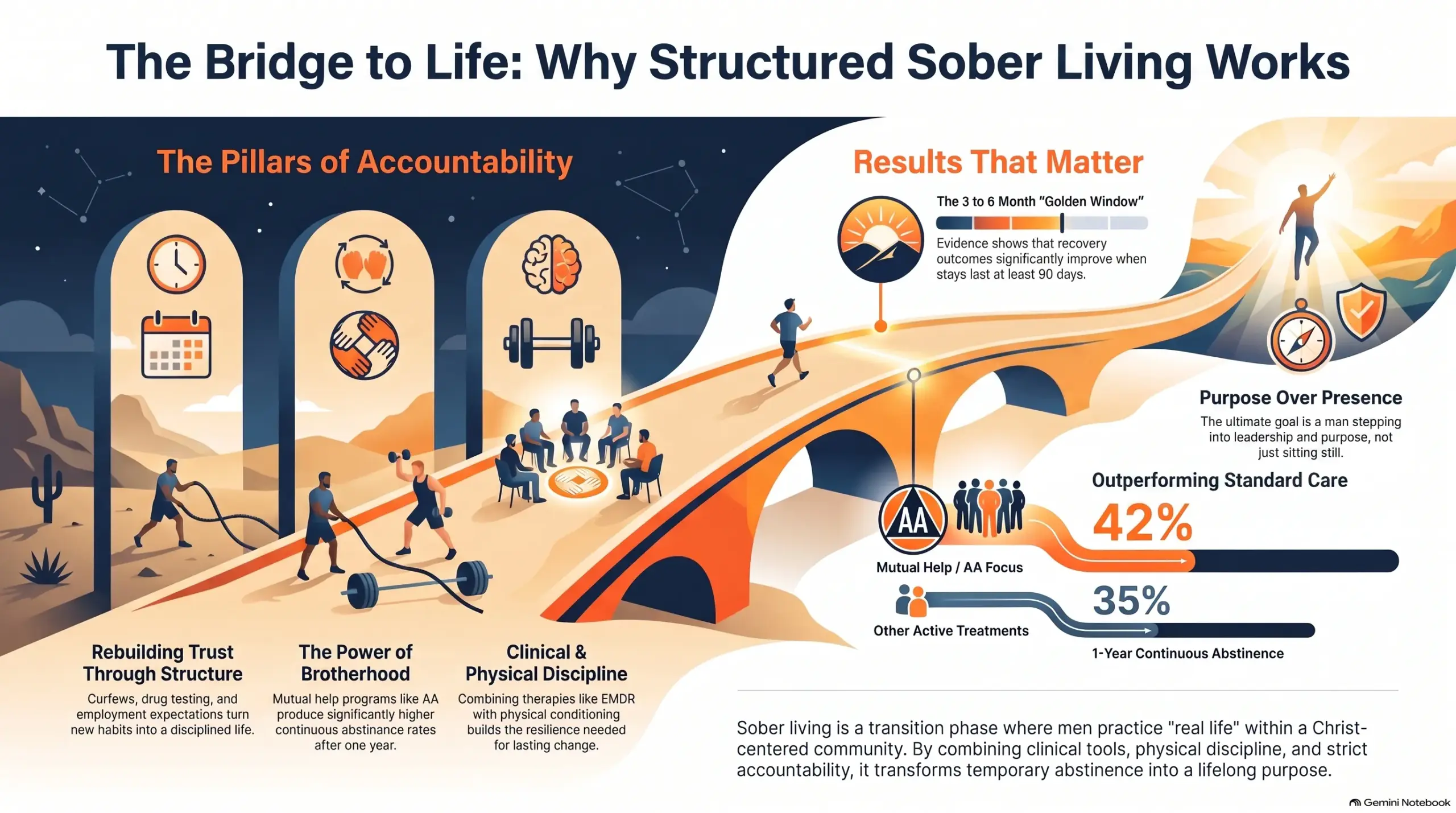
Structured, Christ-centered sober living homes give a man long-term housing with round-the-clock support and accountability from staff:
- Curfews
- Drug testing
- Chores
- Employment expectations
- House meetings he cannot skip
This mechanism rebuilds trust, first with the man himself and then with his loved ones.
What the Research Says About Recovery Housing
Recovery housing is now the most widely available form of recovery support in the country, with roughly 10,000 recovery homes across the United States [2].
A 2025 systematic review of several major studies found that men in recovery housing outperformed those receiving standard continuing care on abstinence, income, and employment, and that recovery housing was the more cost-effective option [2].
Federal guidance from the Substance Abuse and Mental Health Services Administration (SAMHSA) ties certified recovery housing to lower rates of relapse or incarceration, higher income, better employment, and repaired family relationships [4].
How Long Should a Man Stay in Sober Living?
Longer than feels necessary. The available evidence points to three to six months as a working range, and length of stay tracks with better outcomes [2].
Men who leave early almost always leave for the same reason. They feel good, so they assume the work is done. Feeling good at 60 days is a result of the structure, not a reason to walk away from it.
Brotherhood, Discipline, and Purpose Carry the Rest
Programs are scaffolding. What holds a man up over years is what he does every week and who he does it alongside.
Mutual help earns its place here. Programs designed to pull a man into Alcoholics Anonymous (AA) produced higher continuous abstinence at one year than other active treatments, roughly 42% compared with 35% [5].
Biblical 12-step work, a home group, and a sponsor are not soft additions to a plan. They are the part that keeps running after insurance stops paying.
The clinical tools travel with him too. Eye Movement Desensitization and Reprocessing (EMDR), Cognitive Behavioral Therapy (CBT), Internal Family Systems (IFS), and HeartMath™ coherence practice are skills, not appointments. A man who can settle his own nervous system before a hard conversation carries that for life.
So does the body. Strength training and CrossFit-style conditioning build the discipline that shows up everywhere else, and the Arizona high desert keeps a man outside, off the screen, and in open country.
The point of all of it is not a sober man sitting still; it is a man stepping into purpose and becoming the leader of his home.
What if I Relapse After Residential Treatment?
Call us. Do not wait for it to get worse first, and do not go quiet on the men who know you.
A return to use tells you something about what the plan was missing. It is not a verdict on the man. Most people who reach lasting recovery need more than one attempt to get there [2].
 What Matters Most
- Residential treatment stabilizes a man and gets to the root. The year after discharge determines whether that work holds.
- Stepping down through PHP and IOP with the same clinical team preserves the momentum a man built in residential care.
- Sober living supplies the accountability that turns new habits into a life. Three to six months is a reasonable working target [2].
- Continuing care works best when it lasts longer (three to six months as a working range).
- A home group, a sponsor, physical discipline, and men who will tell you the truth are what remains after the clinical work ends.
Rise Stronger in Recovery With AnchorPoint
AnchorPoint Recovery is a Christ-centered residential program for men in Prescott, Arizona, running 30 to 45 days with licensed clinicians, faith-driven therapists, and round-the-clock nursing on a high desert campus. Through our brother program, Holdfast Recovery, that care continues into PHP, IOP, and structured sober living under the same clinical leadership.
We accept most major commercial plans, including Aetna, BlueCross BlueShield, Cigna, United Healthcare, Humana, GEHA, Carelon, ComPsych, and TriWest. Our admissions team will verify your benefits in plain language.
Same-day admission is often available. Call any hour.
Sources
[1] Substance Abuse and Mental Health Services Administration. 2025, Jul. 28. Release of the 2024 National Survey on Drug Use and Health: Leveraging the Latest Substance Use and Mental Health Data to Make America Healthy Again. Substance Abuse and Mental Health Services Administration.
[2] Vilsaint, C. L., et al. 2025. Recovery Housing for Substance Use Disorder: A Systematic Review. Frontiers in Public Health, 13, Article 1506412.
[3] McKay, J. R. 2021. Impact of Continuing Care on Recovery From Substance Use Disorder. Alcohol Research: Current Reviews, 41(1), Article 01.
[4] Substance Abuse and Mental Health Services Administration. 2023. Best Practices for Recovery Housing. SAMHSA Publications, No. PEP23-10-00-002. Substance Abuse and Mental Health Services Administration.
[5] Kelly, J. F., et al. 2020. Alcoholics Anonymous and 12-Step Facilitation Treatments for Alcohol Use Disorder: A Distillation of a 2020 Cochrane Review for Clinicians and Policy Makers. Alcohol and Alcoholism, 55(6), 641–651.