(928) 377-5230

Tim Hayden
Co-Founder
Tim is passionate about serving others, leading people to Christ, and more specifically breaking the stigma of addiction and mental health in the Church and across the world. Tim merges his desire to further the Kingdom with 18 years of experience in the Corporate IT world where his background has ranged from working for small startups to leading national teams at global software companies. Tim graduated from Mount Vernon Nazarene University with a bachelor’s degree in Business Administration, Marketing, and Communications. Tim and his wife are active in their church community serving in the youth department, marriage mentoring, and life group mentoring. In his spare time, Tim enjoys spending time with his family in the great outdoors camping, mountain biking, and snowboarding.
“Do all the good you can, by all the means you can, in all the ways you can, in all the places you can, at all the times you can, to all the people you can, as long as ever you can.” – John Wesley











The 12 Steps of Alcoholics Anonymous have guided millions of people toward lasting sobriety since it was first published in 1939. But for someone new to recovery or a family member trying to understand what a loved one is walking into, the steps can seem mysterious: a list of principles that somehow add up to a changed life.
This article breaks down the 12 Steps, how they support recovery, and how they align with faith-based residential treatment for men seeking a spiritual foundation for their healing.
What Are The 12 Steps of AA?
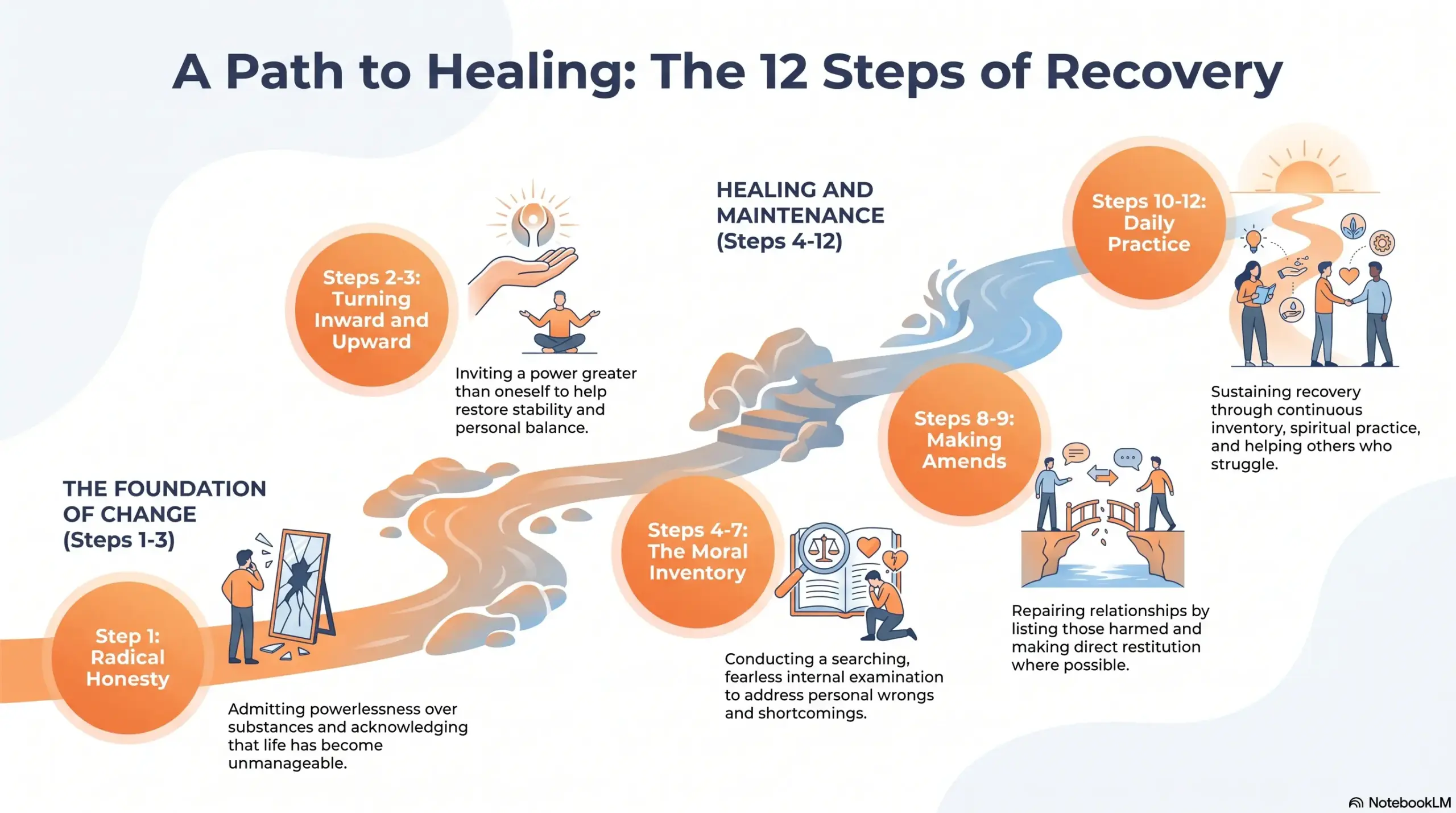
The 12 Steps is a set of guiding principles, originally written by AA’s founders, that describe a course of action for recovering from addiction. They’re meant to be worked in order, usually with the help of a sponsor, and they build on one another. While the exact wording is specific to AA literature, the steps fall into a few groupings based on what they actually ask a person to do [1].
Step 1: Admitting the problem
The first step is honesty: admitting powerlessness over alcohol or another substance and acknowledging that life has become unmanageable. Nothing else can begin until this step is real.
Steps 2 and 3: Turning toward a higher power
These steps introduce the idea that a power greater than oneself can help restore stability, and they invite a decision to trust that power. AA deliberately leaves “God as we understood Him” open to interpretation, so the steps work for people of many beliefs.
Steps 4 through 7: Taking an honest inventory
Here, a person examines their past, makes a searching and fearless moral inventory, admits their wrongs, and becomes willing to have their shortcomings addressed. This is the deep, often uncomfortable internal work of recovery.
Steps 8 and 9: Making amends
The person lists those people they’ve harmed and makes direct amends wherever possible, except when doing so would cause further harm. This repairs relationships and relieves the weight of guilt that often fuels continued use.
Steps 10 through 12: Maintaining and carrying the message
The final steps are about sustaining recovery: continuing to take personal inventory, deepening spiritual practice through prayer and meditation, and helping others who still struggle. Recovery becomes a daily practice rather than a one-time event.
How Do The 12 Steps Support Men in Addiction Recovery?
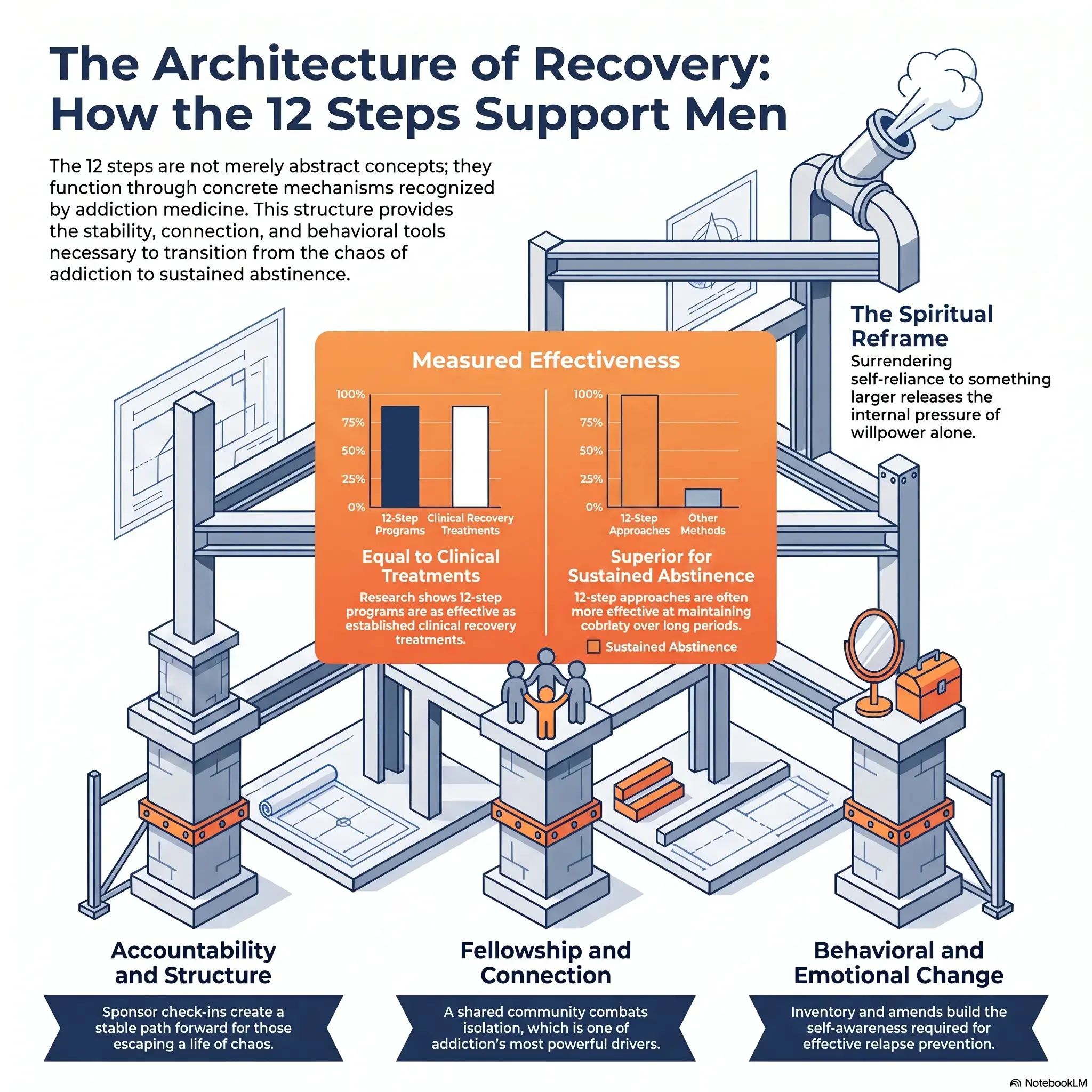
The steps aren’t just abstract ideas. They work through several concrete mechanisms that addiction medicine recognizes as genuinely protective for long-term recovery. The benefits of 12 steps for those in addiction recovery include [2]:
Accountability and structure. Working the steps with a sponsor creates regular check-ins and a clear path forward. For someone whose life has been defined by chaos, that structure is stabilizing in itself.
Fellowship and connection. Isolation is one of addiction’s most powerful drivers. The 12-step community offers belonging, shared experience, and people who understand the struggle without needing it explained. This connection is one of the most consistently cited reasons people stay sober.
Behavioral and emotional change. The inventory and amends steps aren’t just spiritual exercises; they’re practical tools for changing patterns. Confronting past harm, making it right, and continuing to monitor one’s behavior builds the kind of self-awareness that relapse prevention depends on.
A spiritual reframe. For many, the hardest part of addiction is believing they can fix it through willpower alone. The steps replace that exhausting self-reliance with the relief of surrender, turning to something larger than oneself, which can release enormous internal pressure.
This isn’t only anecdotal. A large review of the research found that AA and clinical approaches designed to connect people to 12-step programs are at least as effective as other established treatments at producing abstinence, and often more effective at sustaining it over time [3]. In other words, the steps have measurable results, not just emotional appeal.
How Does Faith-Based Treatment Reinforce the 12 Steps?
Twelve-step programs and professional treatment do different jobs, and they work best together. AA provides lifelong fellowship and a spiritual framework. Residential treatment provides structure, clinical care, medical support, and the concentrated, protected time a person needs to begin healing. The two aren’t competitors; they’re complementary.
The honest moral inventory of Steps 4 and 5 mirrors the self-examination and confession already familiar to many people of faith. The daily spiritual practice of Step 11 fits naturally into a treatment day built around reflection and prayer. For someone who finds meaning in faith, this alignment means the spiritual work they begin in treatment is the same work AA will ask of them for years to come, so there’s no gap between the two.
Some faith-based programs deepen this connection further by integrating spiritual care with current clinical understanding of trauma and the nervous system, recognizing that unaddressed trauma frequently sits underneath addiction.
One example of this integrated approach is the faith-based addiction recovery program for men at AnchorPoint Recovery, which combines evidence-based clinical care and trauma work with a Christ-centered framework.
What Does Recovery Look Like When the Steps and Faith Work Together?
In a community built on honesty and shared belief, there’s less energy spent keeping up appearances and more available for actual healing. Connection deepens because doing hard spiritual work alongside others doing the same builds the kind of bond that addiction’s isolation destroys.
None of this requires perfect faith or any faith at all to begin. The 12 Steps were intentionally written to meet people wherever they are, and millions of agnostics and atheists have successfully worked through them. But for the person who finds that the spiritual core of the steps resonates, a faith-based setting can strengthen that foundation considerably.
Residential Treatment for Men in Arizona: Combining Faith and Clinical Care
At AnchorPoint Recovery, a men’s Christian rehab center in Arizona, recovery is about more than putting down the substance. It’s about rebuilding the whole man — body, mind, and spirit.
AnchorPoint programs combine evidence-based clinical care and trauma work with a Christ-centered framework and the same spiritual principles that have carried people through the 12 Steps for generations.
If you or a man you love is ready to do that deeper work, reach out today for a real conversation about what recovery could look like.
Sources
[1] The Twelve Steps. AA.org.
[2] Alcoholics Anonymous World Services, et al. (2020). Final report of the 2020 General Service Conference: 26th World Service Meeting. Alcoholics Anonymous World Services.
[3] Ferri, M. (2020). Alcoholics Anonymous and other 12-step programs for alcohol use disorder. The Cochrane database of systematic reviews, 3(3), CD012880.